

Bridging Divides: The Annenberg Wildlife Crossing
- Oct 27, 2025
- 3 min read

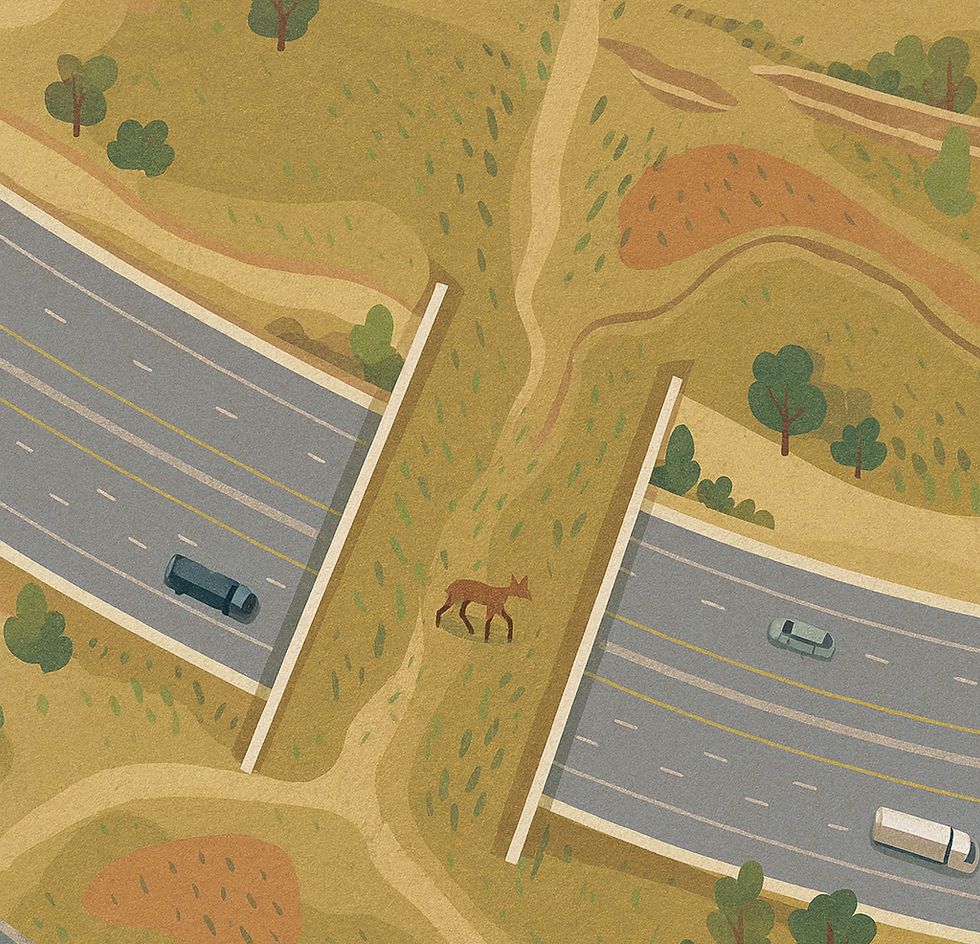
It’s not every day that a freeway learns to breathe again. In Agoura Hills, a bridge is taking shape over the 101 — not for cars, but for paws, hooves, and wings. The Annenberg Wildlife Crossing will reconnect habitats long divided by asphalt, allowing mountain lions, deer, and countless smaller species to move safely between the Santa Monica Mountains and the Simi Hills.
It’s an ambitious idea: to make one of California’s busiest highways passable for wildlife. But as with any major environmental project, it comes with questions — and lessons — about how people and land coexist.
Reconnecting What Was Once One
For decades, the 101 freeway has acted as an invisible wall through Southern California’s ecosystem. Large mammals, especially mountain lions, became isolated on either side — a problem scientists say led to genetic bottlenecks and declining populations.
In 2016, after years of collaboration between Caltrans, the National Wildlife Federation, and the Annenberg Foundation, plans for the world’s largest wildlife bridge took shape.The design: a 210-foot-long vegetated structure spanning ten lanes of freeway, covered in soil and native plants. Construction began in 2022 and is now in its final phase, expected to finish by fall 2026.
Engineering a Living Landscape
This isn’t a simple overpass. It’s an ecosystem built on concrete — complete with drought-tolerant plants, wildlife fencing, and noise barriers that help recreate the conditions of a natural hillside.
More than 6,000 cubic yards of soil will form the foundation for native sage scrub, oaks, and grasses. Once complete, the bridge will provide about one acre of restored habitat, blending seamlessly into the terrain on either side. To many conservationists, it’s a hopeful vision: a freeway that heals instead of harms.
Listening to the Landowners
But not everyone has viewed the crossing with the same enthusiasm. Some nearby farmers and property owners have expressed concern about how the project was planned — from early communication to land impacts along the corridor. Their perspective is an important one: Ventura and its neighboring counties are home to generations of people who’ve worked this land long before it was divided by concrete.
The bridge’s story, then, is not just about wildlife. It’s about dialogue — between agencies, landowners, and communities learning how to share space in new ways. As one local put it during an early public meeting, “We all care about the land. We just want to make sure everyone’s voice is part of how it’s cared for.” It’s a sentiment that fits perfectly with Ventura’s agricultural heart — a reminder that stewardship has many forms.
A Lesson in Coexistence
Whether you tend crops, teach ecology, or simply drive the 101 each day, there’s something universal about this project: it asks us to imagine balance. The bridge is both literal and symbolic — a piece of infrastructure that connects wild spaces while prompting us to look closer at how progress and preservation can work together.
As it nears completion, the crossing has already inspired similar projects around the world. But its truest impact may be quieter: a new way of thinking about how California’s communities, both human and animal, can move forward without leaving one another behind.
Closing Reflection
In Ventura County, where farmlands, foothills, and freeways all share a horizon, the story of the wildlife bridge isn’t just about animals reclaiming their path. It’s about us — the people learning that care for land can take many shapes. Concrete can divide, but it can also connect. And sometimes, the act of building a bridge is less about crossing it, and more about what it teaches us on either side.
Resources
Caltrans – U.S. 101 Wallis Annenberg Wildlife Crossinghttps://dot.ca.gov/caltrans-near-me/district-7/district-7-projects/d7-101-annenberg-wildlife-crossing
Annenberg Foundation – Wildlife Crossing Project Updateshttps://annenberg.org/initiatives/wallis-annenberg-wildlife-crossing
LAist – Construction Enters Final Phase for World’s Largest Wildlife Crossinghttps://laist.com/brief/news/climate-environment/construction-begins-on-annenberg-crossing-final-phase
National Wildlife Federation – Liberty Canyon Corridor Overviewhttps://www.nwf.org/Our-Work/Regional-Centers/California/Wildlife-Crossing
This content is for informational and inspirational purposes only.


Comments